Carole Petipher’s lecture series, The Seine: River of Light and Home to Impressionism, draws deeply on her 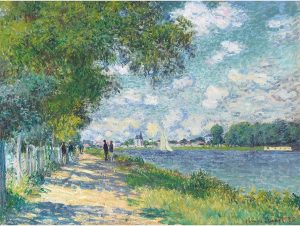 twenty years living and working as a guide along the river on barges and converted cruisers, to offer a vivid, experience-rich exploration of how geography, light, and artistic community shaped one of the most influential movements in art history.
Beginning at the estuary towns of Honfleur and Le Havre, the Seine is presented not merely as a physical waterway but as a dynamic source of inspiration, its shifting light and atmosphere attracting artists, writers, and musicians throughout the nineteenth century. J. M. W. Turner was as a precursor, his atmospheric handling of light and colour influenced later painters who would push beyond traditional landscape conventions.
Among the earliest innovators was Charles-François Daubigny (1817-1878), whose move toward painting outdoors helped bridge the gap between sombre studio landscapes and the lighter, more immediate impressions of nature that would define Impressionism. Similarly, Eugène Boudin (1824-1898), born in Honfleur, became a pioneer of painting en plein air, capturing skies and coastal scenes with remarkable sensitivity; though underappreciated commercially, he was highly respected by his peers such as Jean-Baptiste-Camille Corot (1796-1875). Boudin’s mentorship proved crucial for Claude Monet, who absorbed his teacher’s emphasis on direct observation and light. Monet’s early experiences in this estuarine environment, alongside encounters with artists like Johan Barthold Jongkind (1919-1891) and Gustave Courbet (1819-1877), shaped not only his technique but also his artistic vision. Coastal resorts such as Trouville and Deauville, newly fashionable due to the rise of sea bathing, became fertile ground for their experimentation, with small, rapidly executed paintings catering to a growing tourist market.
The second lecture shifts focus to the formation of Impressionism as a cohesive movement, centred on four key figures: Monet, Camille Pissarro, Alfred Sisley, and also Pierre-Auguste Renoir. Their early years in Paris were marked by ambition and frustration, as they sought acceptance at the prestigious Salon while simultaneously developing a radically different approach to painting. Encounters with Édouard Manet (1832-1883), a central and sometimes controversial figure in the Parisian art world, proved formative, particularly through gatherings at the Café Guerbois, where ideas were debated and alliances formed. Financial hardship forced these artists to relocate to towns along the Seine—Bougival, Louveciennes, and Chatou—where they could live more cheaply and paint directly from nature. This riverside environment became the “cradle of Impressionism,” fostering both collaboration and individual development. Sisley emerged as the most dedicated landscape painter, working outdoors in all conditions, though his commitment limited his commercial success. Pissarro, sociable and intellectually engaged, became a unifying figure within the group, later earning the title “father of Impressionism.” Renoir, by contrast, increasingly turned toward figure painting, capturing the vibrancy of modern social life in works such as Luncheon of the Boating Party.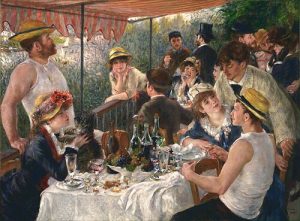 Meanwhile, Monet’s landscapes, including scenes of leisure at La Grenouillère, reflected both the influence of industrialisation and the changing habits of Parisians, who now travelled by rail to suburban retreats. The Franco-Prussian War disrupted their progress, scattering the artists and destroying much of Pissarro’s work, yet these hardships also reinforced their determination to pursue an independent artistic path.
The final lecture traces the gradual emergence of success, both collective and individual, against a backdrop of social and industrial transformation. As Paris expanded and industry encroached on the countryside, the Impressionists continued to draw inspiration from the Seine and its environs. Monet’s move to Argenteuil, supported by Manet and later by his dealer Paul Durand-Ruel, marked a turning point, providing both stability and a base for sustained artistic production. Frustrated by repeated rejection from the Salon, the group established the “Independent Society of Painters, Sculptors, and Engravers” in 1873, organising their own exhibitions. Though initially unsuccessful financially, these exhibitions attracted critical attention, including the satirical review in Le Charivari that inadvertently coined the term “Impressionists,” giving the movement a distinct identity. Over time, individual trajectories diverged: Sisley, plagued by poverty and ill health, struggled to gain recognition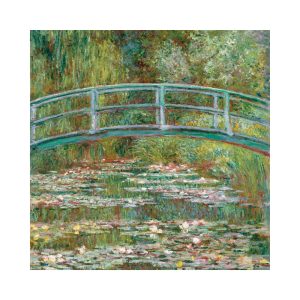 during his lifetime; Pissarro adapted his style and subject matter, eventually achieving success and maintaining strong ties with both Impressionist and Post-Impressionist artists; and Renoir secured popularity through his depictions of social life. Monet, however, emerged as the most enduringly influential figure, his later years at Giverny producing iconic works that cemented his legacy.
Throughout the lectures, Carole Petipher’s storytelling—rich in anecdote and supported by visual material—underscores the central thesis that the Seine was not merely a setting but an active participant in the birth and evolution of Impressionism. It was a river of light and movement that inspired and shaped the artists who painted it, so that they in turn were immortalised through their revolutionary vision.
Liz Beecheno