“Europe has a great deal of art, and America has a great deal of money.” With this remark, Joseph Duveen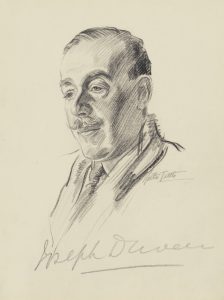 neatly summarised the opportunity that would define his career. Between 1906 and 1939, he persuaded some of America’s richest industrialists to invest in European masterpieces—works that would later form the backbone of major institutions such as the Metropolitan Museum of Art and the National Gallery of Art.
In this engaging lecture, historian Mark Meredith traced the rise of the Duveen family from modest beginnings to establishing a successful antiques business in London before expanding into the United States. Born in Hull in 1877, Joseph Duveen joined his uncle in New York and quickly recognised the potential of a transatlantic art trade. He began acquiring treasures from cash-strapped European aristocrats and selling them to a new class of wealthy American collectors, including J. P. Morgan, William Randolph Hearst, Henry Clay Frick, John D. Rockefeller, and Andrew W. Mellon.
Duveen was the consummate salesman: cultured, persuasive, and endowed with a discerning eye. He specialised in Old Master paintings, and between 1905 and 1908 alone invested an extraordinary $10.5 million in European collections, reselling them at considerable profit.
Central to his success was his understanding of presentation and prestige. His Fifth Avenue gallery, modelled on Paris’s Hôtel de la Marine in the Place de la Concorde, was designed to evoke the atmosphere of a grand European residence. Paintings were displayed in a refined and aspirational lifestyle. Two further galleries followed, each reinforcing his brand of elegance and exclusivity.
Duveen’s genius lay not only in sourcing great works but in shaping his clients’ ambitions. He convinced them that art collecting offered an enduring legacy to rival their commercial achievements – a form of immortality. He assured buyers of both quality and long-term value. Hearst paid $375,000 for Van Dyck’s portrait of Queen Henrietta Maria and Sir Jeffrey Hudson, while Morgan is said to have spent around $1 million annually on art. On one occasion, Morgan tested Duveen’s expertise by asking him to distinguish genuine Chinese ceramics from fakes; Duveen passed with ease.
Duveen frequently acquired works with particular clients already in mind and could significantly enhance the value of collections through his endorsement alone. His influence extended beyond private sales. He played a pivotal role in shaping major collections through his wealthy clients, including the Frick Museum and the Huntington Library, Art Museum, and Botanical Gardens in San Marino, where Henry and Arabella Huntington assembled a remarkable collection that includes Gainsborough’s The Blue Boy.
The economic turmoil of the Great Depression required Duveen to adapt and he continued to apply his expertise, notably in creating the elegant Rose Place for Anne Dodge, furnishing it with fine French objets d’art.
Yet his career was not without controversy. Duveen could be dismissive of works he considered inferior and his public questioning of the authenticity of La Belle Ferronnière, attributed to Leonardo da Vinci and owned by Andrée Hahn, resulted in a widely publicised legal dispute.
In later years, however, doubts emerged about some of the paintings he sold as they have discovered to be fake, while his approach to restoration—then less conservative than today’s standards— has caused irreversible damage.
Despite these criticisms, Duveen amassed immense wealth and was knighted for his services to art. His legacy remains complex: part visionary, part opportunist, yet undeniably transformative.
Mark Meredith’s lecture offered a richly illustrated and lively account of this fascinating figure, bringing to life some of the stories and personalities behind one of the most influential art dealers of the twentieth century.
Liz Beecheno