Author, lecturer, and tour guide Chris Aslan took us on a whistle stop journey through Uzbekistan, the Central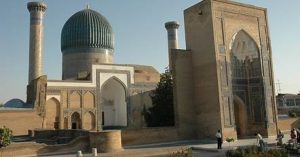 Asian nation whose Silk Road cities once connected the cultures of the East and West.
Beginning in the capital, Tashkent, which came under the control of the Russian Empire in 1865. Much of the city was destroyed during the devastating 1966 Tashkent earthquake and later rebuilt in a stark Soviet brutalist style. Apart from the imposing statue of the conqueror Amir Timur (c.1336–1405), relatively little of the modern city stands out apart from the ornate Tashkent Metro, opened in 1977 and famous for its opulently Soviet designed stations, and the lively Chorsu Bazaar with its colourful produce from across Central Asia. Tashkent is also promoting Islamic heritage tourism through the recently opened Centre for Islamic Civilization in Uzbekistan, which houses the revered Samarkand Kufic Quran.
Next on our journey came the legendary Silk Road city of Samarkand. At its heart lies the magnificent 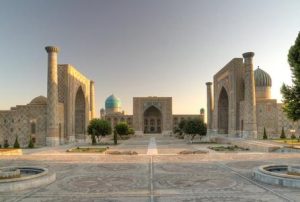 Registan, a vast plaza framed by three richly decorated madrasahs whose dazzling tilework exemplifies the splendour of Timurid architecture. Nearby stands the mausoleum of Amir Timur, the Gur-e-Amir Mausoleum, crowned by its distinctive ribbed turquoise dome. Samarkand flourished as a centre of medieval science under the astronomer-ruler Ulugh Beg (1394–1449) and the city has strong craft traditions, including silk weaving, embroidery, gold thread work, ceramics, and wood carving.
Then on to Bukhara, long a centre of trade, religion, and scholarship. Although its political influence has faded, its historic core remains remarkably intact. Bukhara is especially known for zarduzi, the intricate gold embroidery once used to adorn the robes of emirs and nobility.
Our route ended in the ancient oasis city of Khiva. Divided between the outer town, Dishan Kala, and the walled inner city, Itchan Kala, Khiva preserves a remarkable collection of mosques, madrasahs, and palaces. Its most distinctive landmark is the turquoise-tiled Kalta Minor, famous for its unusual squat form. 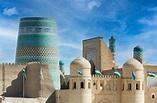
Together, these cities trace the “Golden Road” of the Silk Route, where architecture, textiles, and enduring craft traditions reveal the rich cultural heritage of Uzbekistan.
Liz Beecheno