 Lee Miller was a complex figure. Born Elizabeth Miller in New York back in 1907, the ‘Lee’ bit came later after modelling nude before her Father’s camera from puberty through to her late teens. She had been raped by a family friend at the age of 7 and judging by her photography, these experiences all had a lasting effect on her life.
Tall, willowy and with short-cropped hair, she was very different to the heavily made-up ‘Marilyn Munroe’ type curved figures that would dominate the fashion magazine covers after the 2nd World War. But Miller had an additional strength: She was very bright and used her intellect as much as her looks to wind older men in particular, around her little finger. Never afraid to pose nude or erotically, she charmed her way into the studios of New York’s best photographers and her image began popping up in prestigious fashion spreads both in America and England.
First a supermodel, it was Vogue photographer Edward Steichen who encouraged her to swap sides on the camera. In 1929 she left for Paris, where she apprenticed herself to Man Ray, the celebrated surrealist who 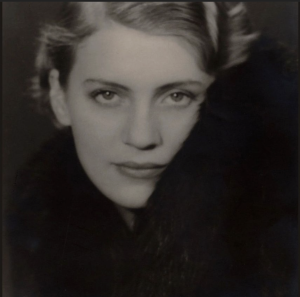 was almost twice her age. She quickly became his collaborator, muse, pupil…and lover! The work they produced together is both moody and surrealistic with unexpected juxta-positions, looming shadows and stark close-ups. Together they invented the technique of solarisation – adding hallows of magical light to their images. Miller, it is suggested, discovered the effect by mistake, inadvertently exposing a printed image to light mid-way through processing. They also made mildly kinky films together, one of which is projected in jerky sepia tones in the exhibition.
Each of Millers many turns in her life are displayed in separate rooms, 11 in all through 232 images. One room is devoted to her time with wealthy Egyptian, Aziz Eloui Bey, whom she tempted away from his wife and married in 1934. Nearly two decades older, Bey encouraged her to concentrate on travel photography as they toured around the Orient. This was not her best work though some images stand out, most notably the shadow from the Great Pyramid at Giza falling across Cairo.
By 1937 life, as a travelling Egyptian wife, had begun to tire and she moved back to Paris where she started an affair with Sir Roland Penrose, another older surrealist painter. They later moved to Hampstead just as war clouds were gathering over London, signalling the start of the Second World War.
Here, the exhibition changes gear as Miller finds a cause of her own, recording the stark images of war. Later, through sheer determination, and perhaps subtle persuasion, she became the first woman war photographer 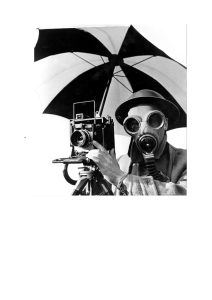 allowed to tour the battlefields of Europe, recording the evidence. One photograph shows herself taking a bath in Hitler’s Munich bathtub on the day he committed suicide, but the most haunting display are pictures taken during the darkest discoveries found at the Dachau and Buchenwald concentration camps. Miller did not hold back, taking stark photographs of corpses piled high on rubbish tips, prisoners reduced to skin and bone, and dead German soldiers floating in the river. All these were sent back to Vogue magazine in London and New York, where to Miller’s fury, editors declined to publish.
The exhibition concludes with Miller and Penrose, now married, settled in a farm cottage in the Sussex Downs where she re-invented herself once more, this time as a latter-day Nigella Lawson. Making the most of rationing at that time, she invented surrealistic dishes like Onion upside-down cake, Charlotte de Tomates, Cairo Cheese and Cucumber salad and Lee’s no-dough pizza. Ever the publicist, she hosted dinner parties for the good and the great within the art world including Picasso, Man Ray and Henry Moore – stories that made their way into the gossip columns, and had her recipes published in Vogue
Later in life Miller was to suffer severe depression, brought on, it is now suggested, by PTSD. She died of lung cancer at the family farm in 1977 aged 70.
The Lee Miller Exhibition remains open at Tate Britain until February 15, 2026.
Barry Pickthall