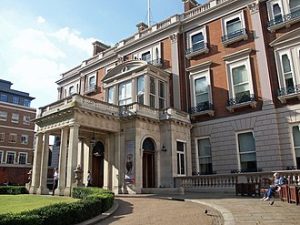
 Speaker Stephen Duffy, gave a fascinating talk about the founding of The Wallace Collection, an outstanding collection of Paintings, furniture, porcerlain, arms and armour. The museum in Hertford House, Manchester Square, London, of which Stephen was formerly Senior Curator, contains 5,500 pieces of art collected by five generations of one family between 1760 and 1880 – the first four Marquesses of Hertford along with Richard Wallace after whom the museum is named.
The first Marquess, brought home six paintings by Canaletto from his visit to Venice on the grand tour. The second Marquess also picked up several paintings on his travels, including Joshua Reynolds’ famous portrait of Nelly O’Brien.
The third Marquess, the first real ‘collector’, added a considerable amount to the collection. He was particularly keen on acquiring 17th Century Dutch work and 18th and early 19th century French furniture and porcelain including several beautiful pieces by sevres.
The fourth Marquess, the main collector, lived in France. On inheriting the title of Marquesss in 1843, he became one of the richest men in Europe using his wealth to build up the collection which included Rembrandt’s ‘Titus, the Artist’s Son’ (1657)’ and Rubens’ ‘The Rainbow Landscape’ (1636). He outrageously paid 51.000 francs at auction for Franz Hals’ ‘The Laughing Cavalier’ (1624 ). His newly acquired purchases, which included much high end furniture, porcelain and oriental arms and armour, were sent back to Hertford House for storage. He never married but had an illegitimate son, Richard Wallace, who he raised from the age of 6 years old.
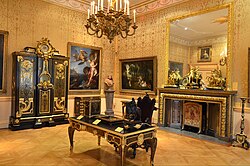 On his father’s death Richard inherited the entire art collection. As a wealthy man he moved to London taking the remaining artwork with him. It was he who set up Hertford House as a museum. He made a crucial difference as he collected Medieval and Renaissance art and glass and also European armour to complement the oriental collection. Sir Richard Wallace died in 1890 having bequeathed everything to his wife, Lady Wallace, who then generously bequeathed the collection to the British Nation. It took three years for the house to be converted into a museum which opened in 1900.
Jackie Bearman