‘Highlights of Maritime Art from the 16th Century’ and ‘Dazzle, Disguise and Disruption’
Dr James Taylor FRS visited The Arts Society via zoom to give two one hour talks on the above topics. About fifty members and visitors attended and the morning was very well received.
The first hour highlighted the numerous forms of painting and art from the 16th century until modern times. We saw many works of art and heard of the lives and stories behind them.
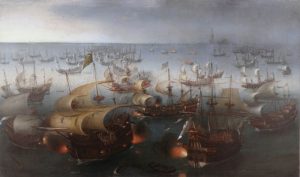
Dutch painter Hendrik C Vroom painted the Spanish Armada and is credited with being the founder of Dutch marine art or seascape painting. Some of his works were turned into tapestries which were later destroyed by fire at the palace of Westminster in 1834.
Willem van de Velde the Younger and Elder both showed the Dutch influence of war at sea in their marine art e.g. ‘The Battle of Scheveningen’.
The talk continued with photographs and paintings of ‘Queens House’ Greenwich, designed by Inigo Jones, and the old Greenwich Hospital for pensioners, which later became the Royal Naval college and houses the magnificent Painted Hall painted by James Thornhill. We were shown a painting by Henry Pidding of the Pensioners at the hospital in 1844 and another by William Hogarth of Captain James Coram, who was a founder of the Foundling hospital in 1739.
James showed us a marvellous photograph taken looking down over Greenwich with the modern skyline in the background and a famous picture of Greenwich, by Canaletto, taken from the Isle of Dogs on the opposite side of the river Thames.
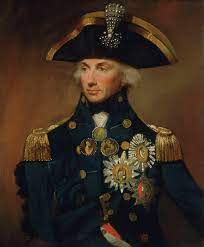
No talk on marine art would be complete without mention of Lord Nelson and the painting of him in his hat with the magnificent diamond cockade, by Lemuel Abbott, which is now hanging at number 10 Downing Street. We went on see Turner’s interpretation of the Battle of Trafalgar; some of his other seascapes; and of course, his artistic impression of the fighting Temeraire being taken by tug to Rotherhithe to be broken up. There are several inaccuracies in this work but Turner has used artistic licence when painting them.
Other notable works of marine art seen include: ‘The British Channel from Dorset Cliffs’ by John Brett, ‘A fish Sale on the Beach’ by Stanhope Forbes – one of the founders of the Newlyn school, ‘Restoration of the HMS Victory’ (1925) by William Lionel Willie and ‘Withdrawal From Dunkirk, June 1940’ by Richard Eunich. We were fortunate to be shown many varied pictures with full explanations behind them all. These works of art show much of our marine heritage.
The second part of the morning was on Dazzle, the camouflage paint which caused deception for both Royal Naval and Merchant ships being torpedoed relentlessly in WW1. Between February and April 1917, U-boats sank more than 500 merchant ships. In the second half of April an average of thirteen were sunk each day. Norman Wilkinson and his team came up with the idea of painting ships with irregular colour patterns to confuse the enemy and deter them from attacking. A truly remarkable idea.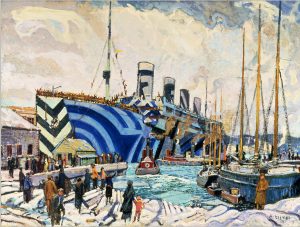
Initially a large number of colours were used in the designs but as the war progressed the U-Boats adopted a neutralising screen which improved range finding. Subsequently the dazzle designs became either black and white, or blue and white which prevented the screen from working.
The Dazzle team included eighteen artists. Large plans and models were made of the ships before transferring the designs to the large vessels. Designs were regularly changed so that the enemy wouldn’t become used to any particular pattern. In all, a few thousand vessels were dazzled, including RMS Olympic, SS Aquitania and HMS Chrysanthemum all of which survived the war.
At the end of the war all of the boats were re-painted in their original colour. Although the authorities claimed that Dazzle hadn’t been effective, Wilkinson was given £2,000 for raising moral amongst the crews which he used to take his team to Claridge’s for tea.
Ros Balfour