
London Bridged: 3,500 years of Crossing the Thames by Charlie Forman.
Lecturer and London Walking Guide Charlie Forman gave us a fascinating historical account of the development of bridges across the Thames, from the time of the bronze age period to the present day. Using a state of the art pinpoint magnifier, Charlie was able to show us details of archaeological remains of ancient bridges still visible at low tide in the Thames today.
The focal point for crossing the Thames was at what is now known as London Bridge where the Romans built their first bridge for their growing city – being the easiest place to cross. There was no other bridge crossing of the Thames until the one at Kingston, so ferries and watermen were used to crossed the river for centuries.
In the 15th Century, the London “draw” bridge with shops and houses on it was well established as a
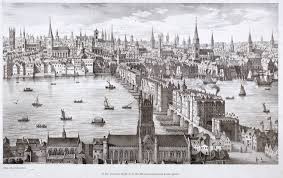 deterrent to marauders. It was also where pilgrims left for Canterbury, but the City elders were not keen to have either disease, entertainment or low life within their city walls, hence it was on the south side that hospitals like St Thomas’s, Guy’s and St Bartholomew’s Hospitals developed as well as Shakespeare’s Globe and Bishops’ Palaces (the Bishop of Winchester had a monopoly on the brothels!)
Amply illustrating his talk with paintings of the period, Charlie described how Putney Bridge was built in 1720, Lambeth Bridge in 1760 and Blackfriar’s Bridge in 1768. Road bridges were built in 1820, and with increasingly sophisticated engineering, railway bridges by 1860 (aimed at bringing commuters into London), tunnels (favoured by Isambard Kingdom Brunel) by 1900. Brunel also built the first foot bridge. Tower Bridge was the first bascule bridge to be built and was completed in 1894. Waterloo Bridge (1903) was the last bridge to be built in the 20th Century until the Millenium Foot bridge.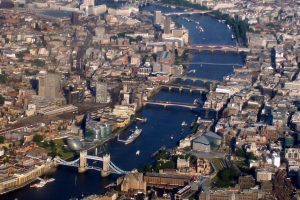
Charlie completed this extensive historical “exposè” saying that a new bridge has been designed to be built from Pimlico to Nine Elms but cannot be started until the Tideway Project is completed.
Liz Beecheno