
Mokuhanga woodcut artist, author, and teacher Carol Wilhide Justin led us on a fascinating exploration of the profound influence of Japanese art on the Western world. After being closed to outsiders for more than two centuries, Japan opened its doors in the 19th century, and since then, its inspiring culture and design have deeply impacted art, cuisine, ceramics, architecture, manga, fashion, Zen philosophy, and even electronics.
The Japanese woodcut technique known as Mokuhanga (moku = wood, hanga = print) developed over many centuries, originally as a means of book production. During the 17th century, numerous illustrated books were produced inexpensively for the mass market. Artisans used cherry wood (sakura) because it handled multiple printings beautifully and retained finely cut, detailed lines. Color printing was achieved through the kento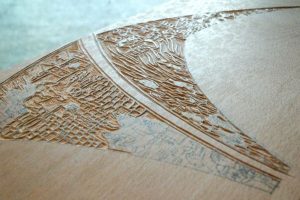 registration system — a small notch carved into the woodblock that kept the paper perfectly aligned. Each colour required its own woodblock, which was inked and printed in succession to build up the complete image.
By the mid-18th century, a thriving mass market for ukiyo-e prints had emerged. These prints depicted scenes from everyday life and popular culture, delighting the merchant and bourgeois classes, though the aristocracy dismissed them as vulgar.
In 1853, the end of Japan’s isolationism marked the beginning of a new cultural exchange. Japanese art and craftsmanship spread rapidly across the world and became highly fashionable. Among the exported masterpieces, Katsushika Hokusai’s (1760–1849) The Great Wave remains the most iconic. European Impressionists such as Degas, Manet, and especially Monet were profoundly influenced by ukiyo-e. Van Gogh also admired the style, freely copying works by Utagawa Hiroshige (1797–1858). Japanese aesthetics extended beyond painting, influencing Western fashion as well; the kimono’s flowing form helped liberate women from restrictive clothing, and much of Liberty’s store collections drew inspiration from Japanese design.
This influence continued well into the 20th and 21st centuries. The rise of Zen Buddhism and the minimalist “less is more” philosophy profoundly shaped Western architecture, notably inspiring Frank Lloyd Wright’s pursuit of structural simplicity. A new generation of artists and designers came to admire Japan’s dedication to nature, craftsmanship, material quality, and meticulous attention to detail — values that continue to shape global art and design today.
Liz Beecheno