
For our first lecture of 2025, which is also the 40th Anniversary year of the founding of the Arts Society in Grayshott, Paul Rabbitts gave a remarkably comprehensive talk on the creation, development and history of the eight London Royal Parks. These comprise Bushy, Green, Greenwich, Hyde Park, Marylebone which became Regent’s, St James’ and Richmond Park.
Greenwich Park was the first area to be enclosed in 1433 and Henry Vlll was born within its 200 acres in the Palace of Placentia. Later James 1st gave the Park to his wife Anne as an apology for being angry with her for accidentally shooting one pf his favourite dogs! Henry Vlll enclosed other areas which he designated as Royal Hunting grounds; namely St James Park in 1532 – described by Paul as a “park of great majesty” because it is surrounded by palaces. Henry Vlll not only courted Anne Boleyn there but he built St James’ Palace as well. In 1603 James Vl of Scotland introduced exotic animals such as leopards and crocodiles into the park and still later Charles ll got the French landscape designer André Le Notre to redesign it into a very formal French garden. Other changes over the years were a canal, the game of Pell Mell (croquet) – hence the name Pall Mall and Birdcage walk where pelicans donated by the Russians were kept. Paul Nash redesigned the park in 1827. St James’ Park is now one of the most popular and most visited of the Royal Parks.
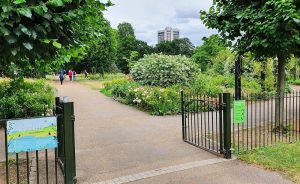 Access was initially denied to the public other than royalty to all these parks but this changed under Oliver Cromwell and the Restoration when Hyde Park (650 acres) became the “People’s Park “ and a fashionable place to be “seen”. Kensington Gardens was created from part of Hyde Park in 1689 by William and Mary and it was there they built their own Royal palace retreat. Hyde Park hosted many celebrations over the years and people skated on the frozen Serpentine lake after its creation in 1730. The Great Exhibition of 1851 took place there and received 6 million visitors. Speaker’s Corner arrived in 1872.
Charles l enclosed all 2500 acres of Richmond Park in 1637 for hunting deer, and even built a 10 mile wall around it. The restricted access to Richmond Park caused a lot of controversy, especially when Princess Amelia (George ll’s daughter) closed it to all but her own friends. However, local brewer John Lewis took her to court over that and won. Unfortunately the court case bankrupted him and he died in poverty. It was used by the army for encampment, training and hospital recuperation during both WWl and WWll.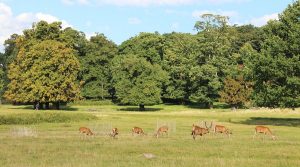
Green Park, the least well known of all the parks, was created and enclosed by Charles ll in 1660 who wanted to walk from Hyde Park to St Jame’s Park without leaving royal soil. Regent’s Park (originally Marylebone Park) on the other hand was commissioned by George lV and designed by Paul Nash and Decimus Burton, and was opened in 1825 to specially favoured people. The London Zoological Society opened it’s Zoo there to the public in 1847.
Paul entertainingly described how all these parks changed over the centuries, with the building of canals, houses and designed gardens; how they were decorated with “park-itecture”, how the building whims of monarchs changed the looks of the parks and how some became notorious whereas others were fashionable. The Royal Parks have always been popular, and today they remain THE most popular London tourist attraction with 7.7 million visitors in a year.
Liz Beecheno